Ragdoll, Birman, Siberian, Maine Coon
Four large semi-longhaired cats: what really sets them apart
See his profile →
All four have a semi-long coat, a generous build and a reputation for gentleness. They are often mentioned in the same breath, and many people hesitate between two of them until the very last moment.
Yet they are very different to live with. Weight almost doubles from one to another, grooming varies enormously from one coat to the next, and each breed has its own health points to watch.
We breed Ragdolls, so we are biased, and we make no secret of it. But all four are fine breeds, and the right cat is the one that fits your life. This page compares the facts, with sources, to help you find it.
At a glance
The four breeds, criterion by criterion
Origin
Build
Adult weight
Female 4–6 kg
Female 3–4.5 kg
Female 3.5–6 kg
Female 4.5–7.5 kg
Coat colour
Undercoat
Brushing
Temperament
HCM screening
Price of a LOOF kitten
median €1,400
median €1,150
median €1,600
median €1,400
Weights: Royal Canin, the CFA and Purina, cross-checked. Prices: our survey of 292 LOOF kitten listings on Chats du Monde, 25 October 2026; each range holds the middle half of the listings. Each section below gives the detail, and its limits.
Size
From medium-sized cat to gentle giant
All four are sturdy cats, but not in the same proportions. The Maine Coon is the largest: the LOOF describes it as the most imposing of domestic cats, and its standard notes that males are clearly more imposing than females.
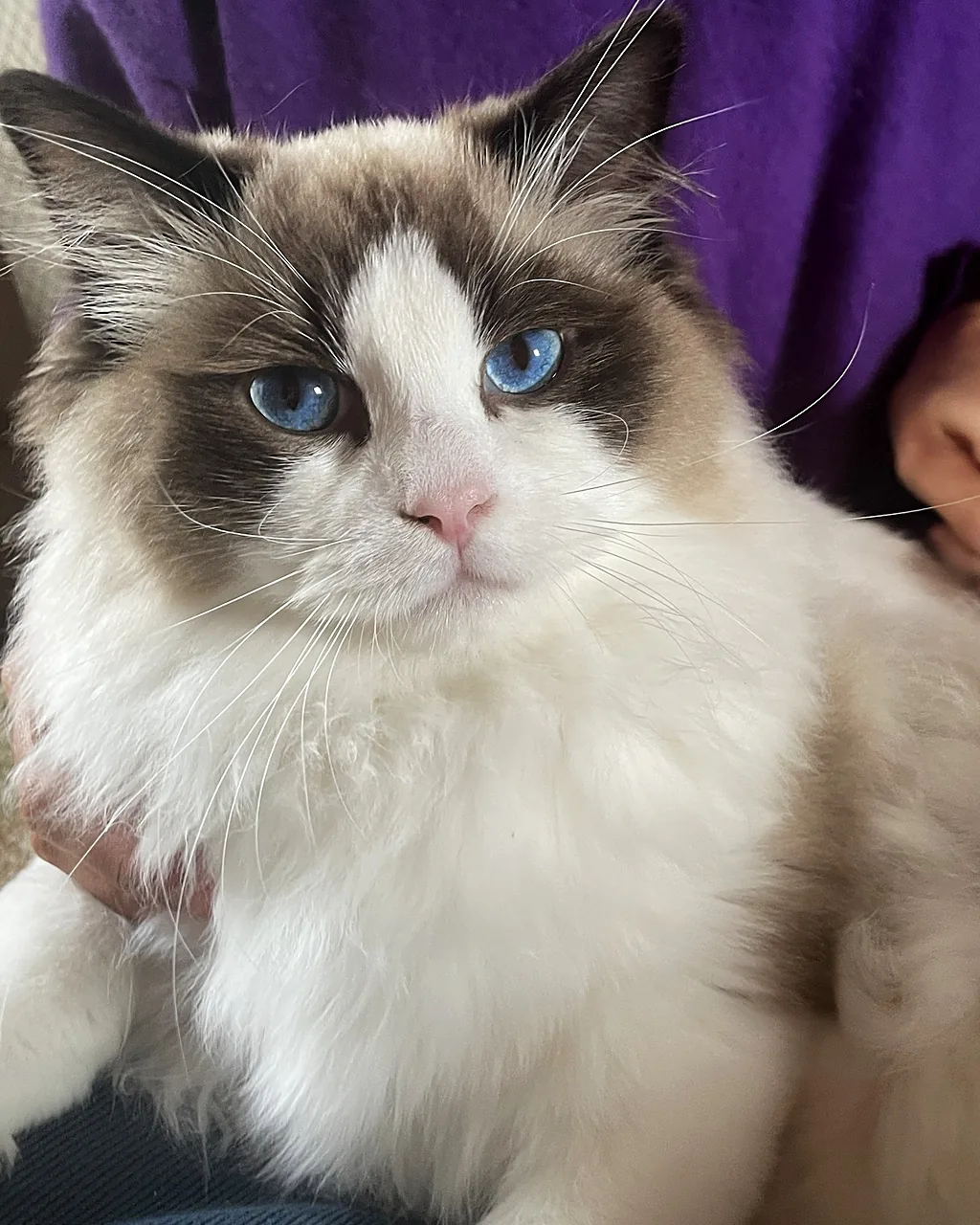
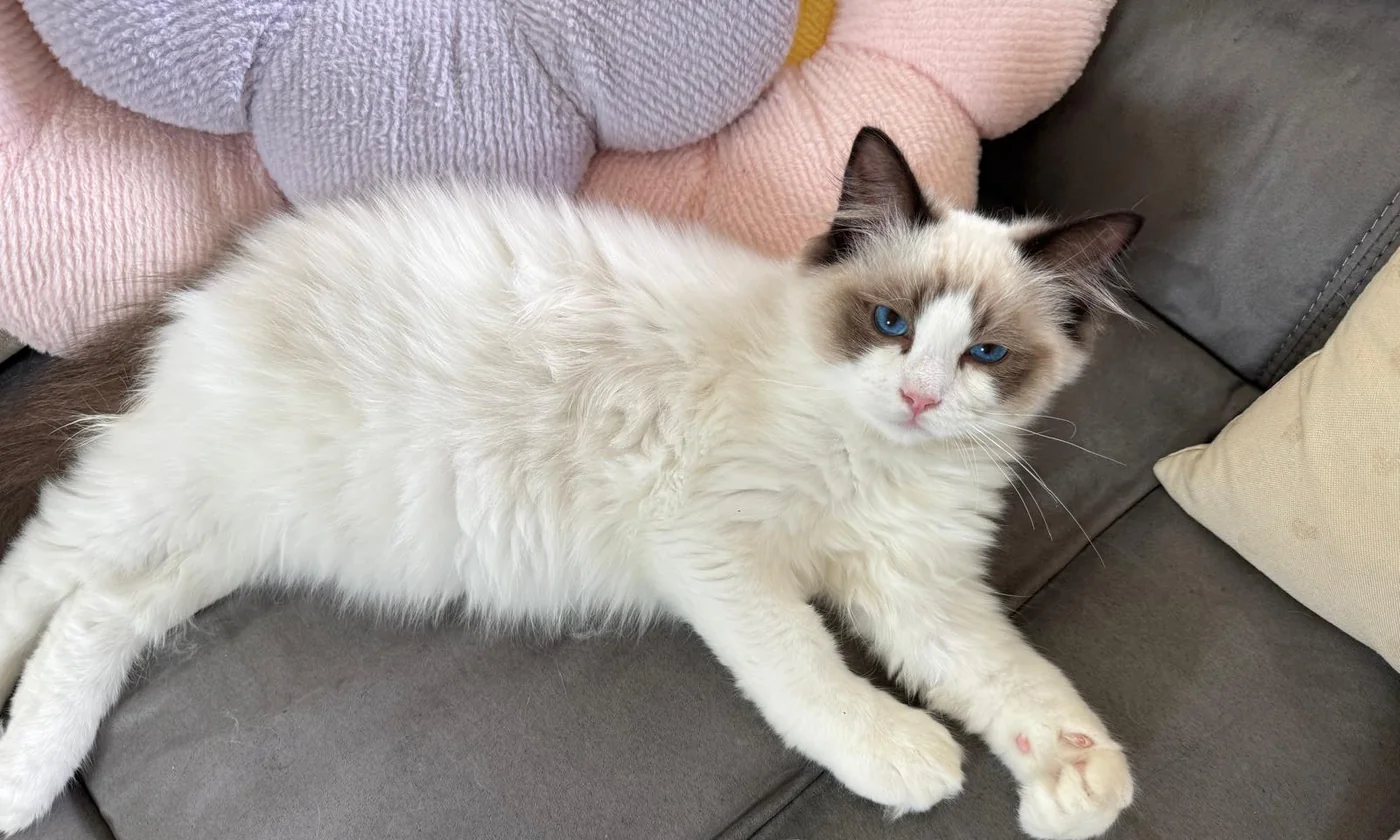
The Ragdoll comes close behind. Its standard describes a long, rectangular body, as wide at the shoulders as at the hips, on heavy bone. It is heavy without being fat: only a small belly pouch is allowed.
See his profile →
The Siberian is a notch below: a medium to large cat, lighter than the Ragdoll, but with rounded, very developed muscles that give an impression of strength. The Birman is the most compact of the four: a medium to sturdy cat, with heavy bone for its size.
One point often surprises people: the gap between males and females can matter more than the gap between breeds. A female Ragdoll weighs about as much as a male Birman.
These are also slow-maturing breeds. According to the CFA, the American cat registry, the Ragdoll only reaches its adult size and weight at around 4 years, the Maine Coon grows until about 3, and the Siberian can take up to 5 years to finish. Plan from the start for equipment sized for the adult: carrier, litter tray and a weighted cat tree.
Coat and grooming
It all happens beneath the surface
From a distance, all four look long-haired. Up close, they are four different coats. What matters for grooming is the undercoat: that is what mats and tangles.
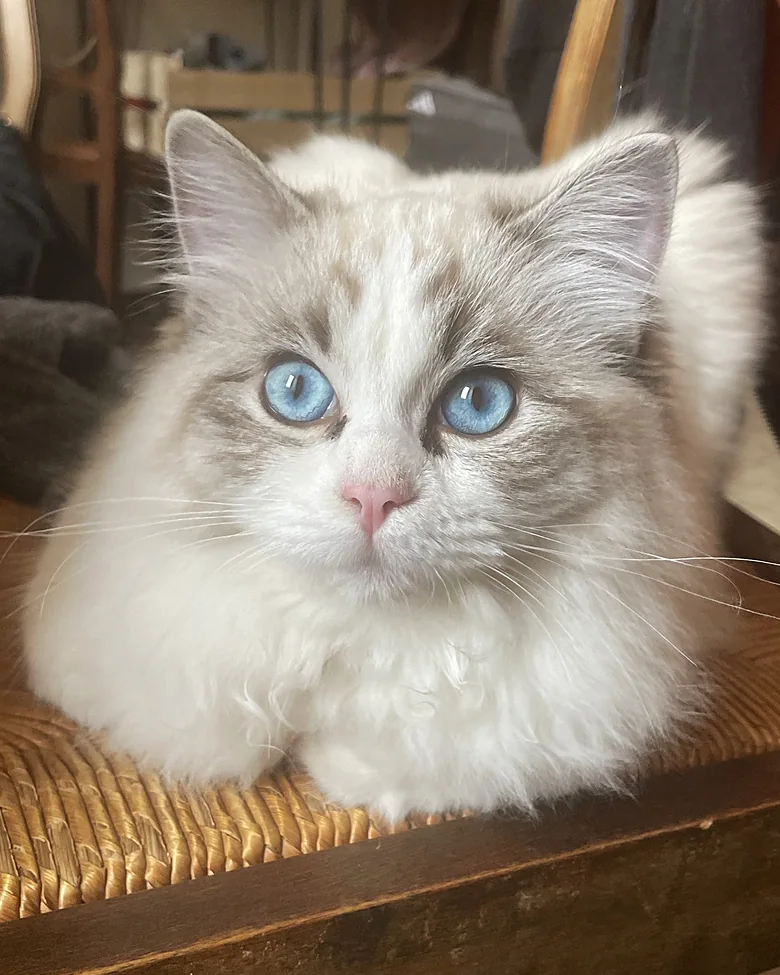
The Ragdoll has a semi-long, silky coat made mostly of guard hairs, with little undercoat. The LOOF considers one brushing a week enough in most cases; the armpits, the ruff and the breeches are the areas to watch. The Birman is very similar: a very silky coat, with a sparse, light undercoat.
See her profile →
The Siberian is the opposite: a triple coat of guard hairs, awn hairs and undercoat, and a water-repellent jacket. Its undercoat, short in summer, becomes dense, long and thick in winter. Yet its needs vary a lot from cat to cat: according to the CFA, some Siberians need weekly brushing, while others can go weeks without. The belly, tail and breeches are the areas to watch.
The Maine Coon has a deliberately uneven coat: short on the shoulders, long on the belly and breeches, with a fine undercoat. A woolly undercoat is even penalised by its standard. Even so, it is the one that needs the most regularity: breeders quoted by the CFA recommend combing two or three times a week, for five to ten minutes.
All of them moult in spring and autumn: none of these four breeds leaves a house free of hair.
Cat allergy comes mainly from one protein, Fel d 1, produced by the skin glands and saliva and then spread over the coat by grooming. Every cat produces it, whatever the length of its hair.
The Siberian is often sold as “hypoallergenic”. An Italian team did find variations in the Fel d 1 genes of Siberians, but concluded itself that it remains to be shown whether they reduce allergen production. The amount also depends on the individual cat: an entire male produces more than a neutered one.
The Ragdoll is no more hypoallergenic than the others. If you are allergic, the only reliable test is to spend time with the cattery’s adult cats before committing.
These are the two breeds most often confused: pointed cats, blue eyes, white on the paws. The Birman always wears its four white “gloves”, extended into laces up the back of the hind legs.
The Ragdoll comes in three patterns. Colourpoint, with no white at all. Mitted, with white mittens but also a white chin and a white stripe along the belly. Bicolour, with a white inverted V on the mask.
A mitted Ragdoll looks a lot like a Birman: check the chin, then the build. Our page on Ragdoll coats details each pattern.
Temperament
Tendencies, not guarantees
Temperament does not fit neatly into a table. The bloodline, the way the kitten was raised and the life you give it count as much as the breed. The tendencies below are real, but they are tendencies.
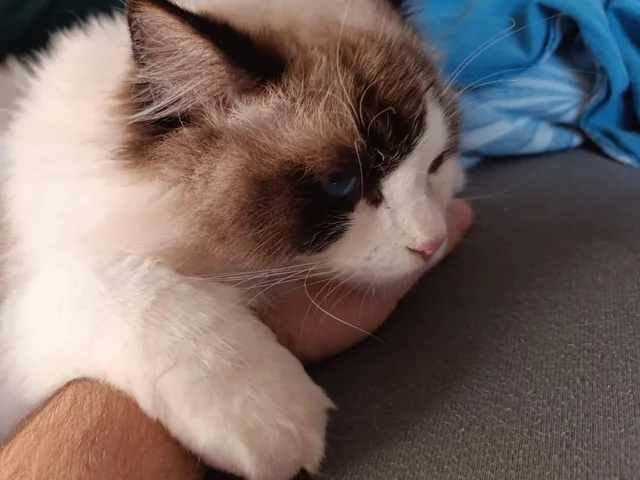
The LOOF describes the Ragdoll as a “quiet strength”. It is a calm, gentle cat, very people-oriented: it greets you at the door, stays close by and often sleeps with you. It lives very well indoors and does not need much space. It is moderately active: it enjoys play without demanding it. The story of the cat that goes limp in your arms comes from the founding queen; most Ragdolls today do not.
See her profile →
The Birman is affectionate, patient and tolerant, which makes it a good family cat. It seeks company, with a soft little voice. The point to watch: it does not cope well with long periods alone. It is the closest to the Ragdoll in temperament.
The Siberian is often compared to a dog: intelligent, very devoted to its people and attuned to their mood. Curious and a born hunter, it inspects cupboards, drawers and suitcases, without being intrusive.
The Maine Coon is sociable, easy-going and playful. The LOOF says it gets on very well with children and can live in a flat if it gets used to it young. It rarely meows, but chirps and trills readily, and many love water.
Health
What to check, breed by breed
All four share a first concern: HCM, hypertrophic cardiomyopathy, the most common heart disease in cats of every breed. What changes is the screening tool. For the Ragdoll and the Maine Coon, a breed-specific mutation is known and can be DNA-tested, in addition to the echocardiogram. For the other two, the heart scan remains the reference tool.
Each breed then has its own points to ask the breeder about.
HCM: a Ragdoll-specific mutation, R820W on the MyBPC3 gene, was identified in 2007. Published estimates put carriers at around 15 to 20 %. The DNA test is done once; the echocardiogram is repeated, because a negative test does not rule out HCM from another cause.
PKD: polycystic kidney disease concerns the Ragdoll through its Persian ancestry. A DNA test gives a definitive status from kittenhood.
Everything is detailed on our health and screening page, with the results of our own breeding cats.
Congenital hypotrichosis: a recessive disease specific to the breed. Affected kittens are born without hair and without a thymus; none of the kittens described lived beyond eight months. A French team identified the mutation, on the FOXN1 gene, and estimated healthy carriers at 3.2 % of its panel. A DNA test exists: ask for it for both parents.
Kidneys: the Birman naturally has higher creatinine than the average cat. In an Italian study, 40 % of healthy Birmans exceeded the threshold that places a cat in stage 2 kidney disease. Measuring SDMA proved more reliable in them.
In practice, always tell your vet the breed before a blood test, to avoid a false diagnosis.
HCM: no Siberian-specific mutation is known. PawPeds’ health programme for the breed relies on heart scans performed by approved vets.
Like the Birman, the Siberian naturally has higher creatinine than average: here too, tell your vet.
HCM: the Maine Coon has its own mutation, A31P, on the same gene as the Ragdoll but at a different position. The two tests are not interchangeable. Publications estimate it is carried by 34 to 42 % of Maine Coons worldwide, and a follow-up study saw every cat with two copies develop HCM before the age of 5.
Spinal muscular atrophy (SMA): a recessive disease of the motor neurons. Affected kittens show a swaying gait at around 3 to 4 months, then weakness in the hindquarters. A DNA test exists.
Hip dysplasia: in the registry of the OFA, the American Orthopedic Foundation for Animals, 24.9 % of the 2,548 Maine Coons X-rayed were dysplastic. Ask for the parents’ hip X-rays.
Whatever the breed, two questions are enough to sort through many listings: which tests for both parents, and when was their last heart scan? Our page Choosing a good cattery gives the other markers.
Budget
At purchase, then every month
To compare with the same method, on 25 October 2026 we surveyed the listings of LOOF-registered kittens published on Chats du Monde: 292 listings, 68 to 79 per breed. The ranges below hold the middle half of the listings; bloodline, coat and cattery account for the rest.
Median €1,400, across 79 listings ranging from €900 to €1,800. The Ragdoll Club France, for its part, recommends €1,500 to €1,800. All the detail, and what the price should include, is on our Ragdoll price page.
The most affordable of the four to buy: median €1,150, across 69 listings ranging from €450 to €1,750.
The most expensive of the four: median €1,600, across 76 listings ranging from €950 to €2,000. Be wary of listings that justify the price with a “hypoallergenic” kitten: see above.
The same price as the Ragdoll: median €1,400, across 68 listings ranging from €700 to €2,000. A low price should prompt you to check the tests: with HCM, SMA and dysplasia, it is the breed of the four that calls for the most screening.
Day to day, the gap is smaller than you might think. A cat’s energy needs do not follow its weight but a power of it, close to 0.67. An 8 kg cat therefore needs about 1.6 times the energy of a 4 kg cat, not twice as much. A big male Ragdoll or Maine Coon costs more to feed than a Birman, but not in proportion to the scales.
The rest depends mostly on size and coat: larger equipment for the two giants, more combing time for the Maine Coon. For food, our dry food comparison gives prices per kilo. And for an adult cat, a shelter remains a real option, at €150 to €400 in adoption fees.
Which one is you?
Four portraits to help you decide
The Ragdoll
You are looking for a large, calm cat that follows you everywhere, is happy to be carried and lives very well indoors. You have ten minutes a week to brush it, and time to play with it.
The Birman
You love the Ragdoll’s gentleness, in a more compact size and at a lower purchase price, and someone is often at home.
The Siberian
You want an almost dog-like companion, curious about everything and very devoted, in a medium to large size.
The Maine Coon
You dream of the largest of the four, sociable and patient with children, and you have the space, and a few minutes of combing, to match.
If you recognised yourself in the first portrait, each of our cats has a full profile, pedigree and tests included. And if it is another one, so much the better: a good choice matters more than one more kitten from us.
Frequently asked questions
The questions we are asked most often. Each answer opens with a click.
Both are pointed cats with blue eyes, but the Ragdoll is clearly larger: a male weighs 5 to 9 kg, against 4 to 7 kg for a Birman. The Birman always has four white feet, like gloves. The Ragdoll comes in three patterns: colourpoint with no white, mitted with white mittens and a white chin, or bicolour with a white inverted V on the mask. Both are gentle and close to their people; the Birman copes less well with being left alone.
No. The Maine Coon is the larger of the two: the LOOF describes it as the most imposing of domestic cats, and a male can exceed 10 kg. The Ragdoll is a large, heavy cat, 5 to 9 kg for a male, but it stays a notch below. The gap between males and females often matters more than the gap between these two breeds.
No cat breed is hypoallergenic. The Siberian also produces Fel d 1, the protein behind most cat allergies. Variations have been found in its genes, but their real effect on the amount of allergen has yet to be shown. If you are allergic, spend time with the cattery’s adult cats before committing, whatever the breed.
The Ragdoll and the Birman: their semi-long coat has little undercoat, and one brushing a week is usually enough. The Maine Coon needs the most regularity, with two or three combings a week. The Siberian has the densest coat, but its needs vary a lot from cat to cat, from once a week to almost never.
Across 292 LOOF kitten listings surveyed on 25 October 2026, the Ragdoll and the Maine Coon share the same median, €1,400. The Siberian is the most expensive, with a median of €1,600, and the Birman the most affordable, at €1,150. Half of the Ragdoll listings fall between €1,300 and €1,550. Day to day, a large cat eats a little more, but not in proportion to its weight.
Sources
We are not vets: this page explains published standards and studies, it does not replace clinical advice.
LOOF — Ragdoll standard (2023, in French) · LOOF — Birman standard (2020, in French) · LOOF — Siberian standard (2023, in French) · LOOF — Maine Coon standard (2023, in French) · LOOF — Ragdoll breed sheet · LOOF — Maine Coon breed sheet · CFA — Ragdoll, Birman, Siberian and Maine Coon (weight, growth, grooming, temperament) · Royal Canin — Ragdoll, Siberian and Maine Coon weight (in French) · Purina — Birman (weight) · Prices: survey by the Chatterie des Iris Polaires, 25 October 2026, LOOF kitten listings on Chats du Monde (Ragdoll 79, Birman 69, Siberian 76, Maine Coon 68; in French) · Abitbol et al., PLoS ONE, 2015 — Birman hypotrichosis (FOXN1) · Paltrinieri et al., Journal of Feline Medicine and Surgery, 2017 — creatinine and SDMA in Birmans · Sartore et al., Veterinary Sciences, 2017 — Fel d 1 genes in the Siberian · Sukumolanan and Petchdee, Veterinary World, 2022 — the Maine Coon A31P mutation · PawPeds — Spinal muscular atrophy in Maine Coons · PawPeds — Siberian health programme · Loder and Todhunter — Demographics of hip dysplasia in the Maine Coon cat (OFA registry) · National Research Council, Nutrient Requirements of Dogs and Cats, 2006 (energy requirements).
Our next litter
Our first litter, Bijou × Brontë, is expected in 2027: seal kittens, bicolour or mitted, from two DNA-tested parents. Our waiting list is free and without obligation.
Discover the Bijou × Brontë litter